Product successfully added to your shopping cart
Quantity
Total
There are 0 items in your cart. There is 1 item in your cart.
Total products
Total shipping To be determined
Total

2.5L 20v - DAZA DNWA
Manufacturers
2.5L 20v - DAZA DNWA
Warning: Last items in stock!
New product
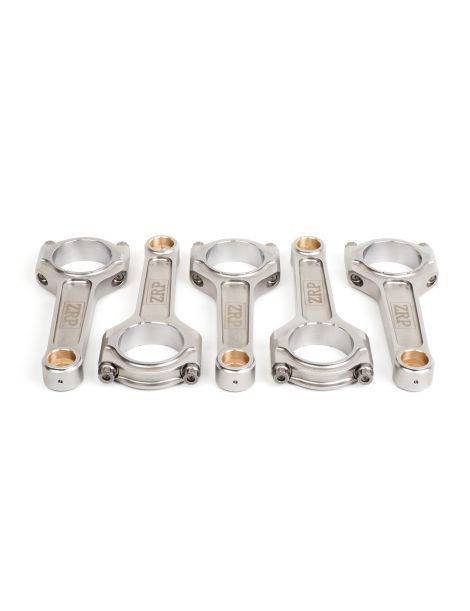
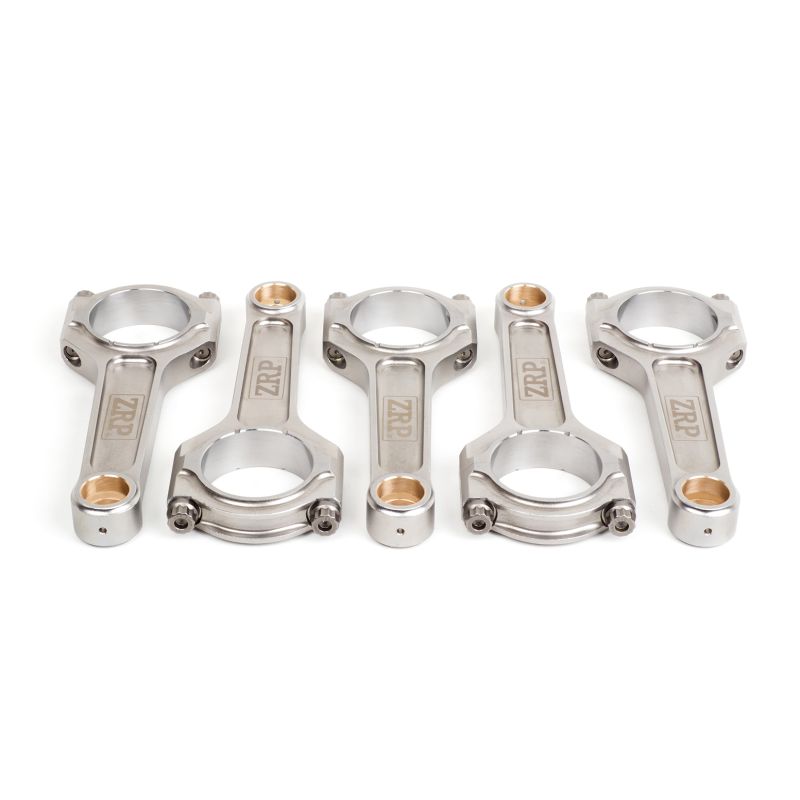
Set of 5 forged connecting rods in 4340 steel for the Audi 2.5 TFSI EA855 EVO (with oil hole).
The 2.5 TFSI EVO (engine code EA855 EVO) is the second generation of Audi's famous inline five-cylinder: 2,480 cc, direct injection and turbocharging. Introduced in 2015, it drops the cast-iron block of the first version for an aluminium crankcase with plasma-coated liners, shedding around 26 kg. Its twin-cam, 20-valve head and 1-2-4-5-3 firing order preserve the unmistakable sound of the family that built Audi's rally legend.
Fitted to the RS3 (8V), TT RS (FV) and RS Q3 (F3), it delivers 367 to 400 hp as standard and has repeatedly won International Engine of the Year. That high potential is also its weak point: as soon as boost pressure and rpm climb, the factory rotating assembly becomes the limiting link, which is why forged rods built for competition make sense.
In practice the standard EA855 EVO rod copes without complaint with factory mapping, but it was calculated for 367 to 400 hp: beyond that, every increase in boost pressure raises the compression load and then the tension at the end of the power stroke, until the part deforms and breaks. Since the five-cylinder delivers torque across a wide band and lends itself to sustained revs, safety means a weight-matched set of five forged rods and forged pistons, fitted together.
These rods are forged from high-strength 4340 steel: a low-alloy nickel-chromium-molybdenum grade, quenched and tempered, which offers a high yield strength and a fatigue endurance far above that of a production rod. That is what makes the EA855 EVO five-cylinder bottom end reliable as soon as power progresses, and what becomes mandatory when moving to forged pistons, raising the rev limit, increasing boost pressure or gaining displacement. The ZRP IR profile, 508 g for a 144 mm centre-to-centre and a 23 mm pin, keeps the small-end oiling hole.
Sized for modified engines, turbocharged or supercharged, they cover every discipline: rally, drift, drag, circuit and trackdays, hillclimb, time attack, and they support Stage 2, Stage 3 and Stage 4+ builds right up to the competition block.
| Reference | Brand | Profile | Bolts | Pin Ø OEM 23 mm | Small-end width | Big-end Ø OEM 50,6 mm | Big-end width | Center-to-center OEM 144 mm | Weight/rod |
|---|---|---|---|---|---|---|---|---|---|
| R-VW-008-IR-5 | ZRP | IR | ARP 2000-3/8"-38mm | 23 mm | 50,6 mm | 21,85 mm | 144 mm | 508 g | |
| R-VW-008-IR-5-L19 | ZRP | IR | ARP L19-3/8"-38mm | 23 mm | 50,6 mm | 21,85 mm | 144 mm | 508 g |
On this oiling-hole version, the drilling changes nothing about the tightening method: it only means checking the passage is clear before closing up. The tightening itself is done in two stages, with a felt-pen mark on the bolt head to follow the rotation from one pass to the next and to spot at a glance a bolt that has been missed or done twice. The torque and stretch values in the table are those specified by the bolt manufacturer, ARP 2000 or ARP L19 in 3/8" 38 mm depending on the variant, and must be followed scrupulously; stretch measured on the gauge remains the reference, before and after tightening.
| Rod | Bolts | Tightening torque | Recommended stretch |
|---|---|---|---|
| R-VW-008-IR-5 | ARP 2000-3/8"-38mm | 61 N·m | 0,140 à 0,152 mm |
| R-VW-008-IR-5-L19 | ARP L19-3/8"-38mm | 67,8 N·m | 0,152 à 0,165 mm |
| 4340 is a low-alloy steel whose composition — nickel, chromium and molybdenum — explains its career in aerospace and then in motorsport: nickel provides toughness, chromium hardenability, molybdenum stability of the structure during tempering. Shaped by hot die forging, the steel has its grain following the outline of the rod instead of being cut through; quenching followed by tempering then sets the hardness without making the part brittle. The gain over a sintered-metal production rod can be measured: around 19 % more yield strength, 8 % more tensile strength and 19 to 37 % more fatigue strength, which multiplies service life under alternating load. On a boosted five-cylinder working at high cylinder pressure, that reserve is what allows high power without gambling the season on every dyno run. |
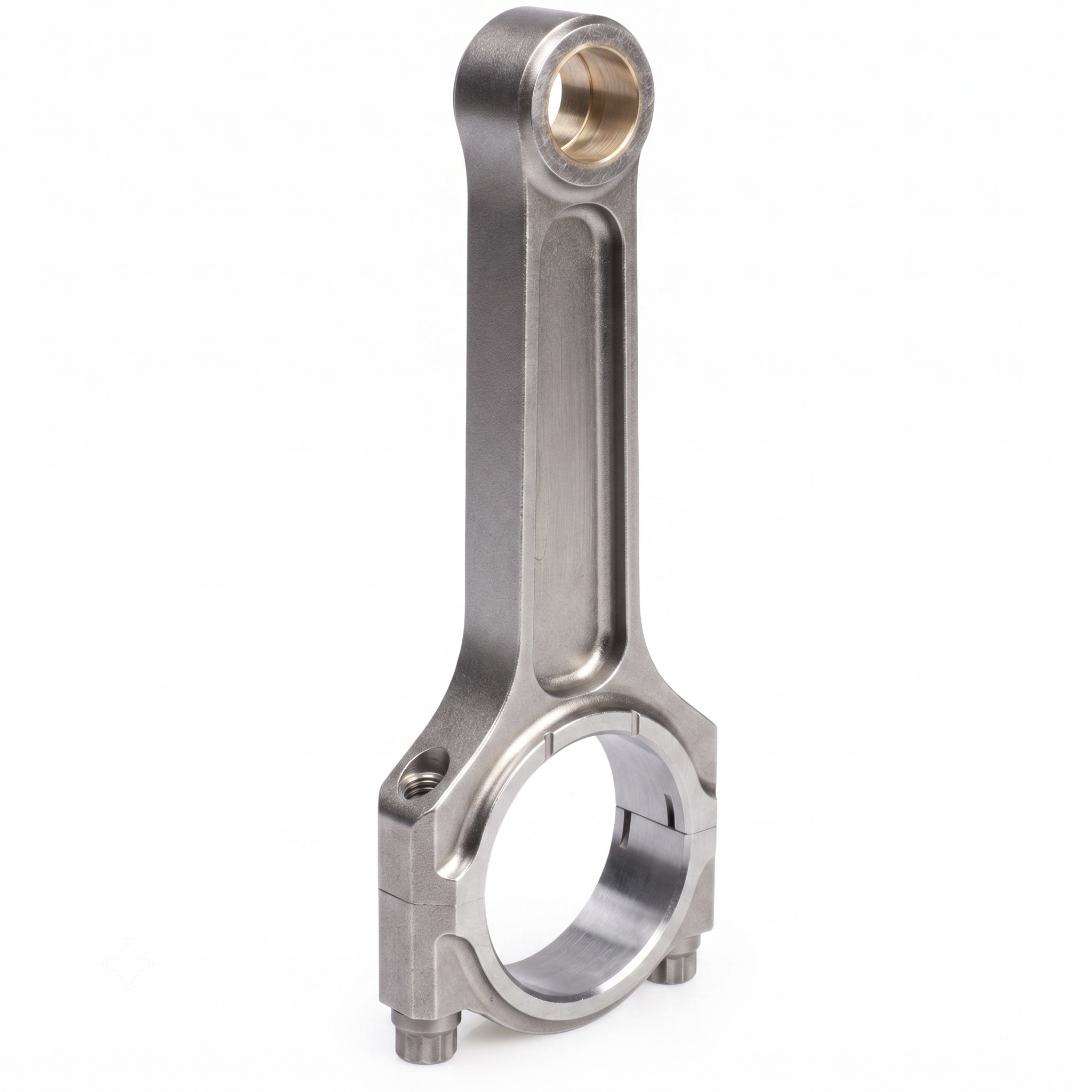 | IR profile (drilled I-beam). An I section whose low weight limits inertia loads on the big end and the bearings, combined with oil holes that feed the small end and the piston pin. That extra lubrication matters on a boosted engine whose thermal load stays high in sustained use. ZRP rates this version up to 600 hp, which covers the vast majority of 2.5 TFSI builds. |
A note on the oil hole: the rods shown here are the rifle-drilled version (with oil hole), recommended up to around 600 hp. The solid-body version (no oil hole), for maximum strength including beyond 600 hp, is covered by a dedicated listing.
On a rod bolt, metallurgy makes the difference on several levels: the alloy grade sets the yield strength and the tensile strength, the way the quench and temper are run determines how uniform the structure is through the whole section, and the rolling of the threads, done after that treatment, work-hardens the thread root, the only area where a fatigue crack really starts. Add corrosion resistance, possible sensitivity to hydrogen and dimensional consistency, which conditions the equality of preloads. This five-cylinder takes its bolts in 3/8"-38 mm in two grades; choose according to target boost pressure and engine speed, then tighten by measured stretch.
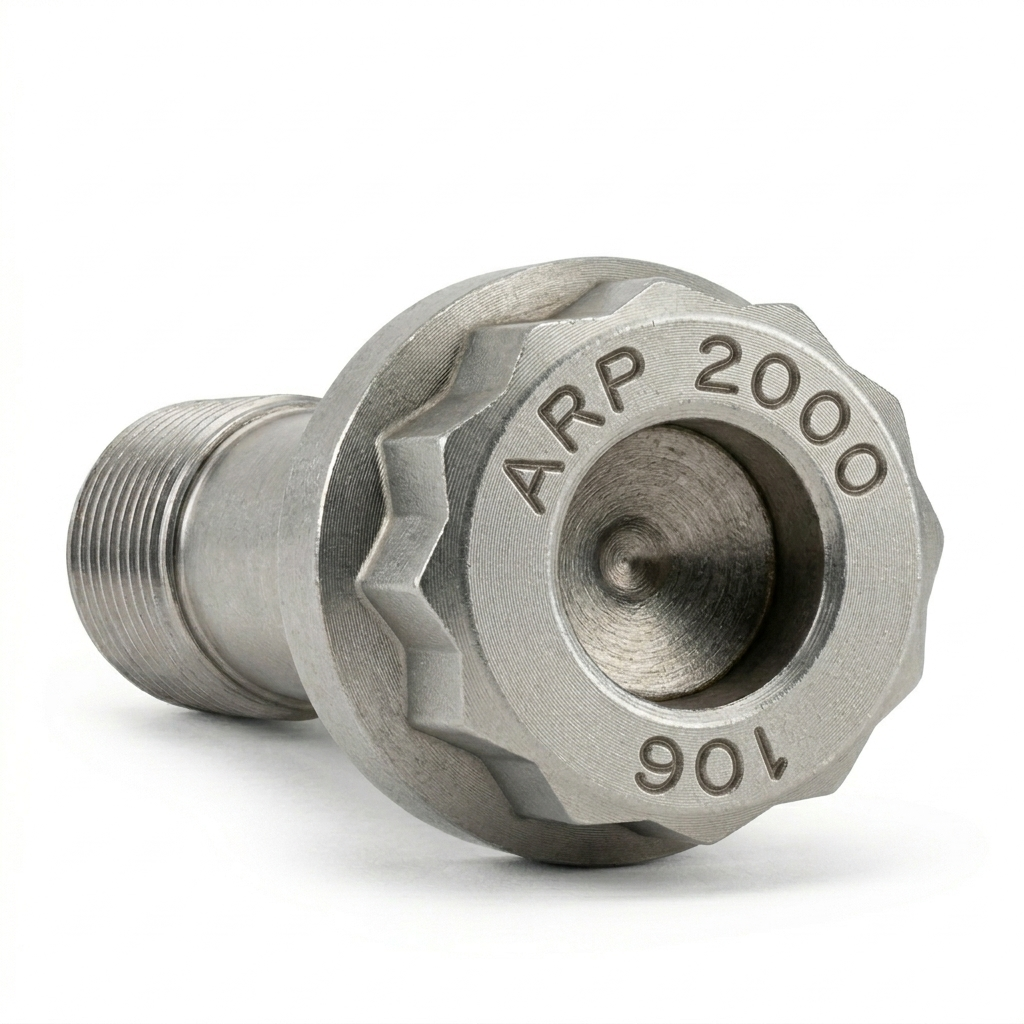 | ARP 2000 (tensile strength around 220,000 psi, close to 1,517 MPa) is the reference grade for engine building. In 3/8" it covers engines up to 200 hp per cylinder and speeds up to 8,500 rpm, which matches almost every 2.5 TFSI built for circuit racing, rally, drift or hillclimb. It needs no particular storage precautions and is torqued here to 61 N·m, for a stretch of 0.140 to 0.152 mm. |
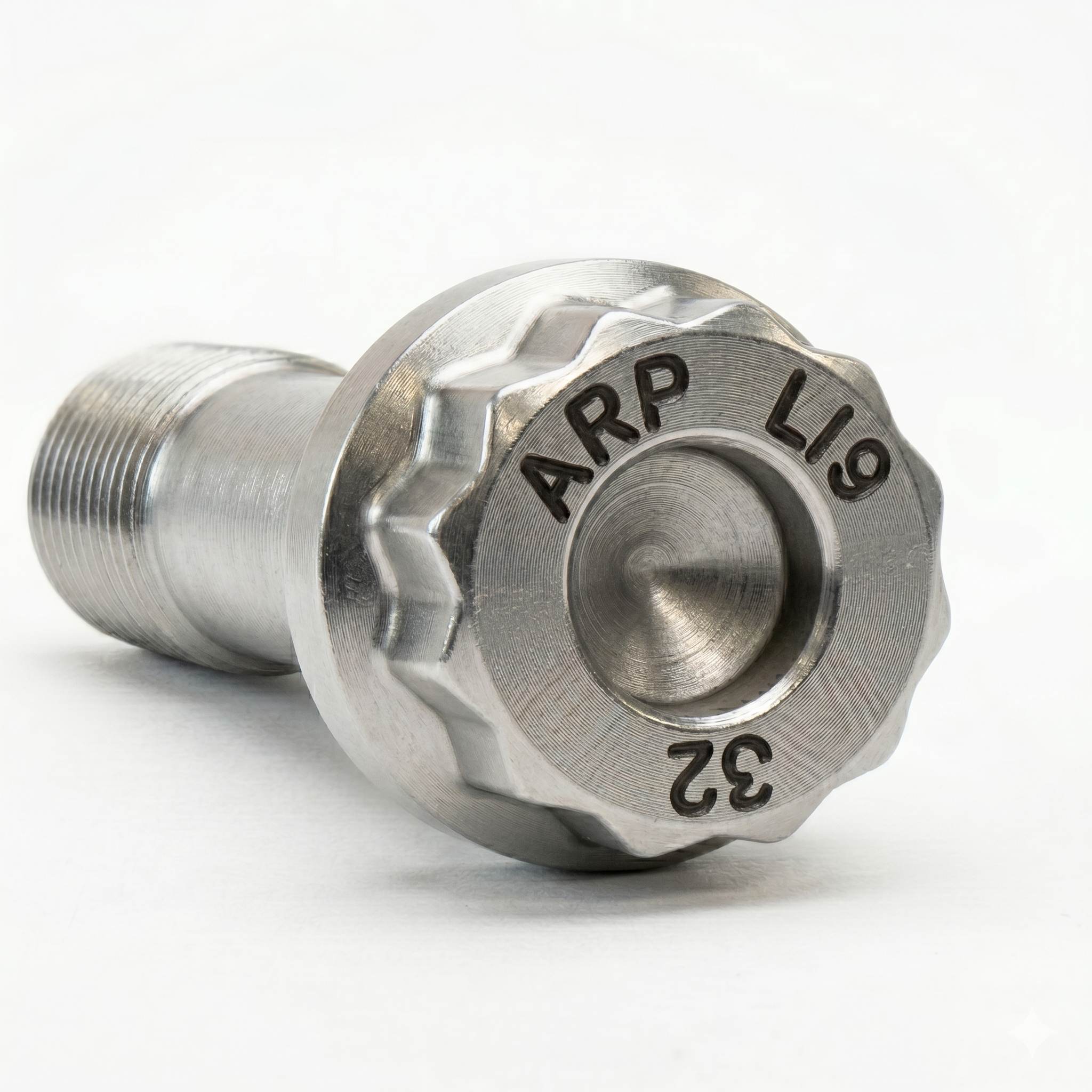 | ARP L19 (tensile strength around 260,000 psi, close to 1,793 MPa) is aimed at engines pushed further: high boost pressure, high revs held for long periods, elevated cylinder pressure. In 3/8" it targets builds up to 250 hp per cylinder and speeds up to 10,000 rpm, the usual ground of drag-racing or time-attack RS3 and TT RS. Its trade-off is metallurgical: the alloy is sensitive to corrosion and to hydrogen embrittlement, so it must be stored and fitted oiled, away from moisture. Torque 67.8 N·m, stretch 0.152 to 0.165 mm. |
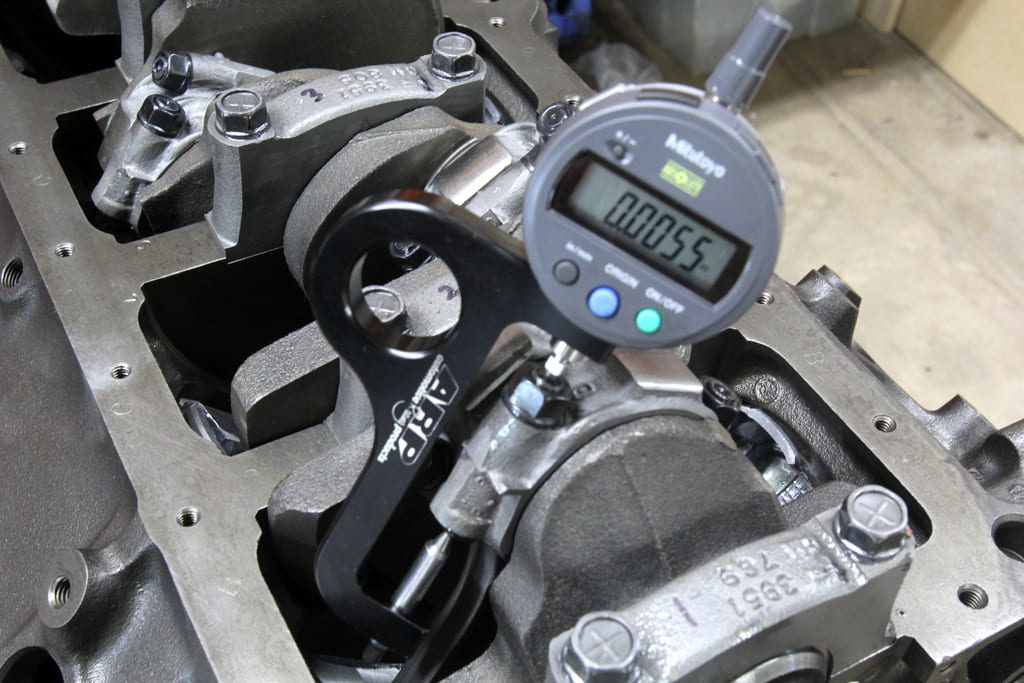
| In addition to torque tightening, measuring bolt stretch (stretch gauge) remains the most reliable way to ensure correct preload. It removes thread-friction variation and secures every assembly. The instructions supplied with the kit always take precedence; the torque figures assume ARP lubricant is used. |
 | ZRP designs and manufactures its forged connecting rods in Greece, in Athens, around the work of Alex Drakos. The material is 4340 steel, die-forged then CNC machined, with dimensional inspection and weight matching to ±1 g across the whole set. The brand made its name on European boosted engines, the Audi five-cylinders among them, and supplies its rods with the ARP hardware of your choice, ARP 2000 or L19. |
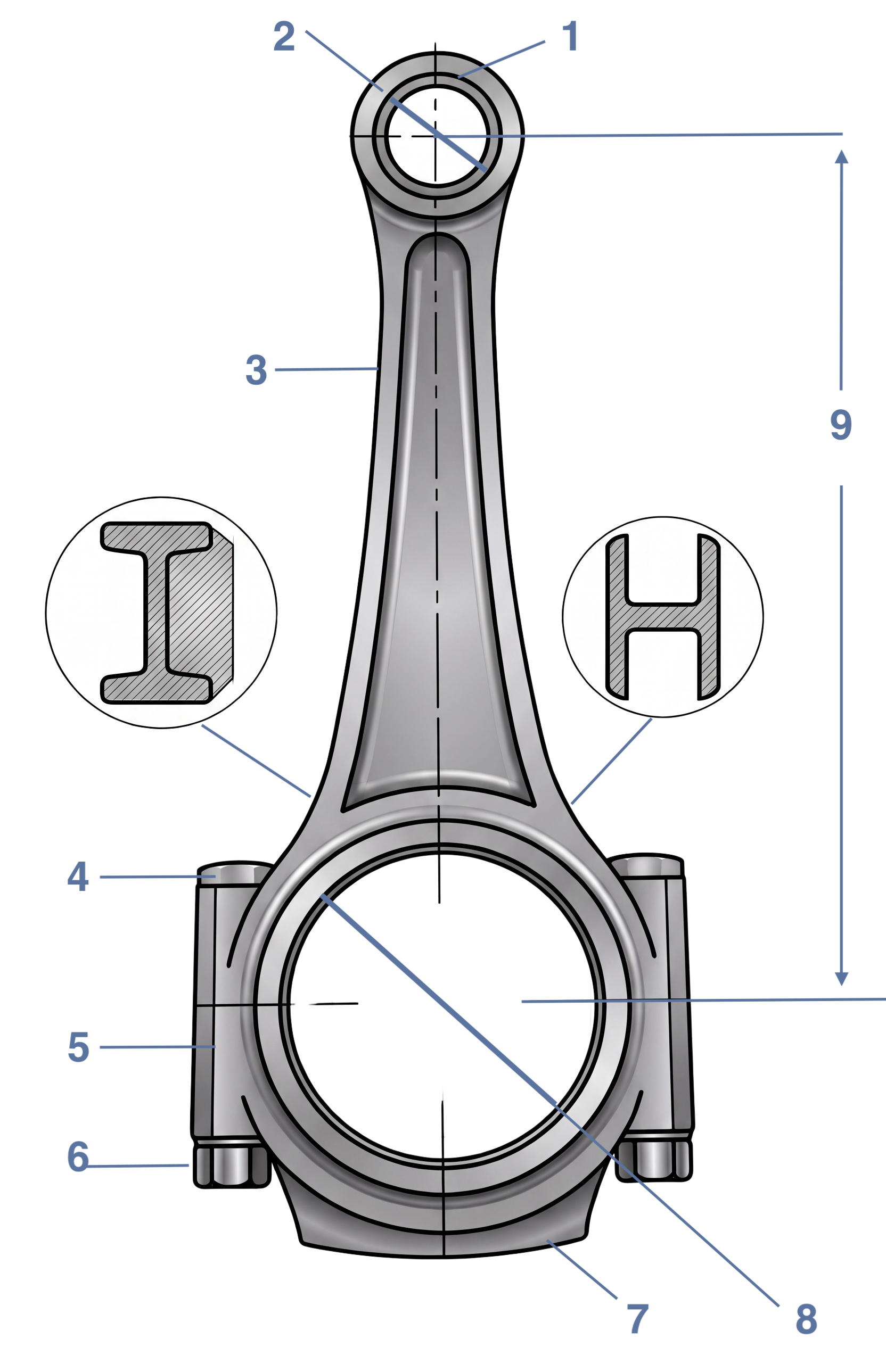 | 1) Small end 2) Small-end diameter 3) Rod beam 4) Rod bolt 5) Big end 6) Rod nut / bolt 7) Rod cap 8) Big-end diameter 9) Center-to-center |
The table below lists the EVO versions of the Audi 2.5 TFSI five-cylinder, with a 23 mm piston pin, that these forged rods with an oil hole are made for. Check the engine code of the vehicle before ordering; the solid-body rods, without an oil hole, are offered on a separate page.
| Make | Model (chassis) | Engine code | Power | Years |
|---|---|---|---|---|
| Audi | RS3 (8V facelift) | DAZA | 400 hp | 2017–2020 |
| Audi | TT RS (FV / 8S) | DAZA | 400 hp | 2016–2020 |
| Audi | RS Q3 / RS Q3 Sportback (F3) | DNWA | 400 hp | 2019–2020 |
When a standard rod breaks on an EA855 EVO, the repair does not stop with it: the rods AND the pistons, almost always damaged in the same incident, have to be replaced, and the crankshaft and bearings have to be checked. The bill for a simple return to the factory configuration becomes very high.
For an equivalent or even lower budget, a set of 4340 forged rods combined with forged pistons brings reliability and a safety margin beyond comparison, with real room to raise power on this boosted five-cylinder. This has been the choice of European engine builders for more than fifteen years.
For the same budget: more reliability, more potential and more longevity for the bottom end.