Product successfully added to your shopping cart
Quantity
Total
There are 0 items in your cart. There is 1 item in your cart.
Total products
Total shipping To be determined
Total

V6 Busso (AR064)
Manufacturers
V6 Busso (AR064)
Warning: Last items in stock!
New product
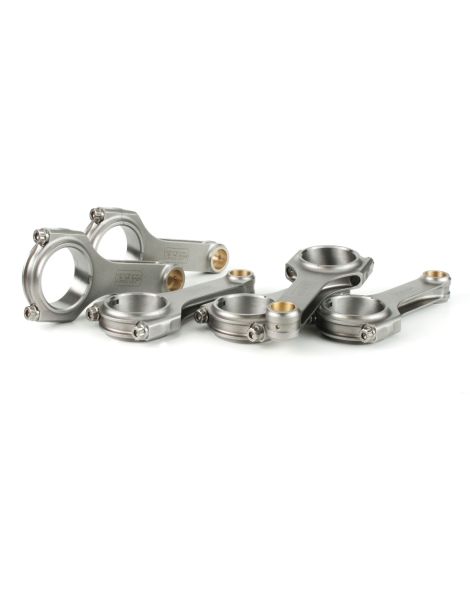
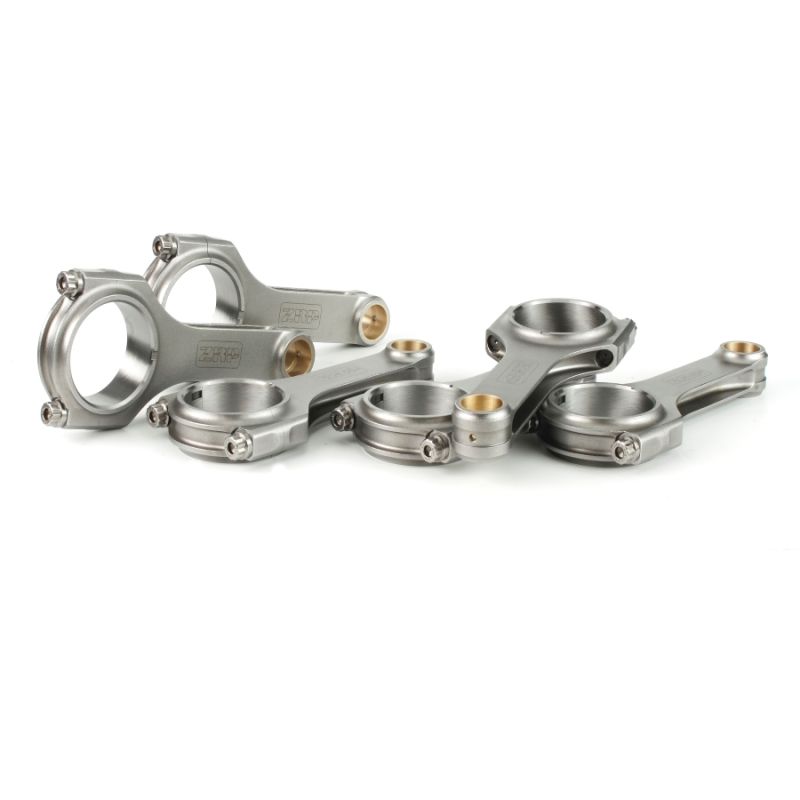
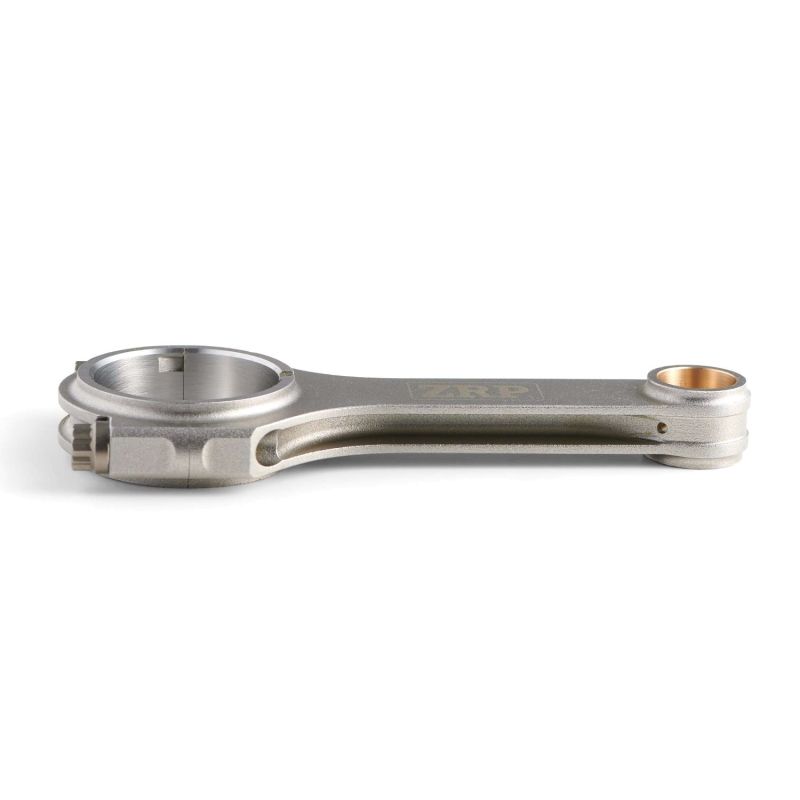
Set of 6 forged 4340 steel connecting rods for the Alfa Romeo V6 Busso 2.5 / 3.0.
Designed by engineer Giuseppe Busso, the Alfa Romeo V6 (code AR064) is an all-aluminium 60° engine introduced in 1979 and built until the mid-2000s. Initially a single-overhead-cam 12-valve, it moved in 1993 to a twin-cam 24-valve head. The rod offered here covers the 2.5 V6 12v (2,492 cc, 88 mm bore and 68.3 mm stroke) and 3.0 V6 24v (2,959 cc, 93 mm and 72.6 mm) versions.
Naturally aspirated, celebrated for its sound and flexibility, the Busso V6 powers the Alfa 75, the GTV6 and the 164 and 166 saloons. It is one of the marque’s most cherished engines: to handle a higher compression ratio, more revs or a forced-induction conversion, the factory rods are replaced with reinforced forged 4340 rods, paired with forged pistons.
With every cycle, the connecting rod converts the piston’s reciprocating motion into crankshaft rotation: violently compressed at combustion, then stretched at the end of the exhaust stroke. On a stock engine these loads stay contained; in a build, as revs climb, the compression ratio rises or forced induction is added, they grow and the factory rod, often sintered and calibrated for manufacturing cost, becomes the most exposed link.
Hot-forged from 4340 steel, the reinforced rod has an oriented grain flow that greatly increases its resistance to fatigue and breakage. Precision-machined, balanced and clamped by high-performance hardware, it brings lasting reliability to the bottom end. Designed for built engines, these forged rods suit every discipline (rally, drift, drag racing, circuit and track days, hillclimb, time attack) and support Stage 2, Stage 3 and Stage 4+ builds, up to full competition engines.
| Reference | Brand | Profile | Hardware | Pin diameter OEM 22 mm | Small-end width | Big-end diameter OEM n.p. | Big-end width | Centre distance OEM 131 mm | Weight per rod |
|---|---|---|---|---|---|---|---|---|---|
| R-ALF-004H | ZRP | H | ARP 2000 - 3/8" - 38 mm | 22 mm | 55.5 mm | 24.8 mm | 131 mm | 478 g | |
| R-ALF-004H-L19 | ZRP | H | ARP L19 - 3/8" - 38 mm | 22 mm | 55.5 mm | 24.8 mm | 131 mm | 478 g |
| Rod | Hardware | Torque | Recommended stretch |
|---|---|---|---|
| ZRP H-Beam (R-ALF-004H) | ARP 2000 | 61 N·m | 0.140 – 0.152 mm |
| ZRP H-Beam (R-ALF-004H-L19) | ARP L19 | 67.8 N·m | 0.152 – 0.165 mm |
On a Busso V6, the job is organised before the wrench comes out: the six rods are laid out bank by bank, caps marked to their own rod, and all twelve free lengths are read on the gauge and written down before any tightening starts. Without that baseline the loaded measurement means nothing, and it becomes impossible to tell which of the twelve bolts has moved. The hardware offered is ARP 2000 or ARP L19 in 3/8" 38 mm; the torque figures and stretch ranges in the table are those specified by its manufacturer and are to be followed scrupulously, measured stretch being the only reference.
| 4340 is a low-alloy steel with nickel, chromium and molybdenum, used in aerospace and motorsport for its rare balance of strength and toughness. Forged and then heat-treated by quenching and tempering, it offers excellent tensile strength, outstanding fatigue endurance and genuine ductility that lets it absorb shock loads without breaking. Compared with the sintered metal of a stock rod, optimised for mass production, forged 4340 shows about 19% more yield strength, nearly 8% more tensile strength and 19 to 37% more fatigue resistance, for a service life under cyclic load several times longer. It is the reference material for high-performance rods. |
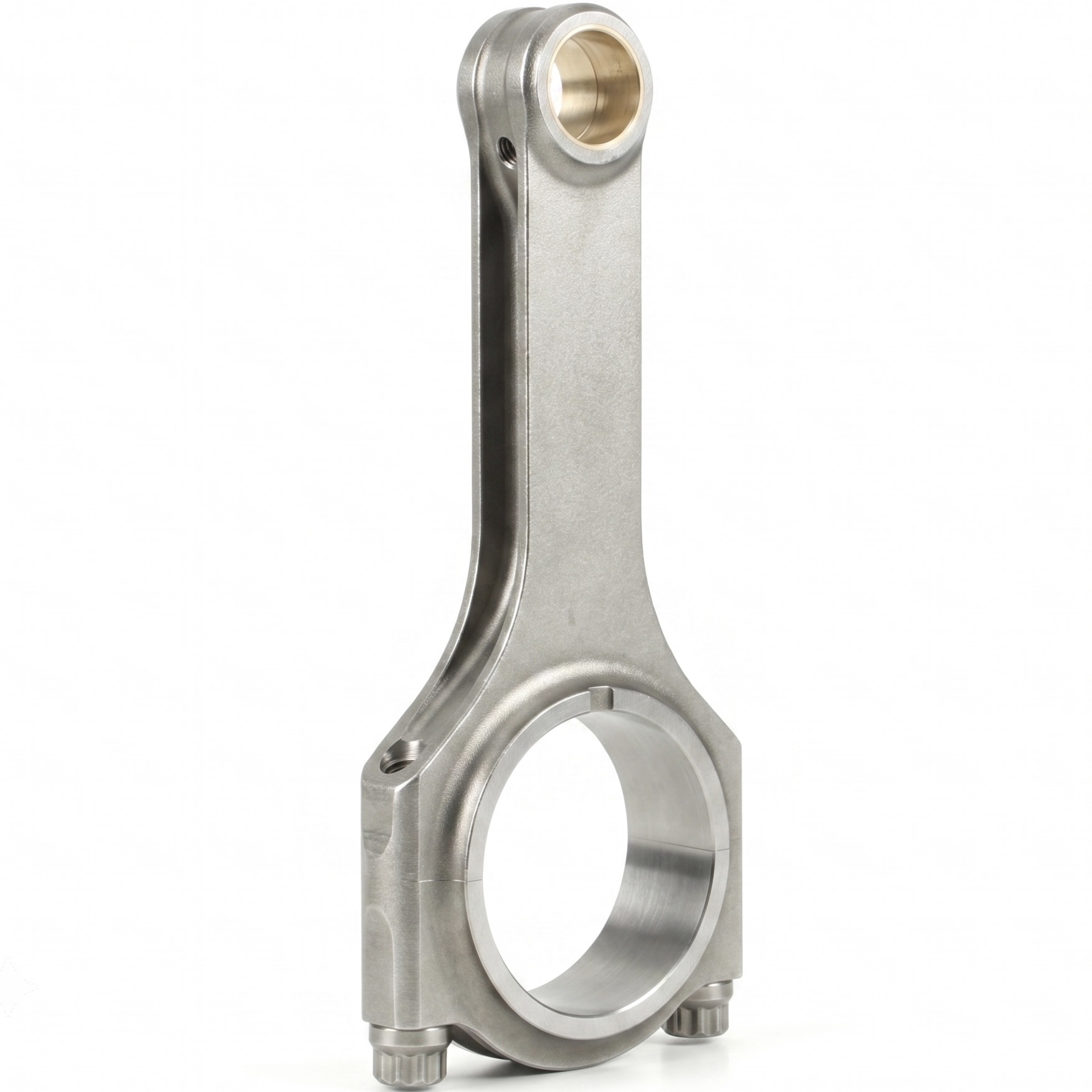 | H-beam profile: the body is relieved on both faces and framed by two thick flanks that give it an excellent stiffness-to-weight ratio. Strong in both compression and bending, the H-beam favours strength: it is the profile of choice for high-torque engines, large displacements and naturally aspirated V6s that rev high, such as the Busso. It is the profile chosen for these rods. |
The rod bolt is among the most heavily loaded parts in the engine: it holds the cap closed on the big end and keeps the assembly together with every revolution. The key is to match the ARP grade to the build’s real use, then to follow the tightening torque and stretch to the letter. Two ARP grades are offered for this engine:
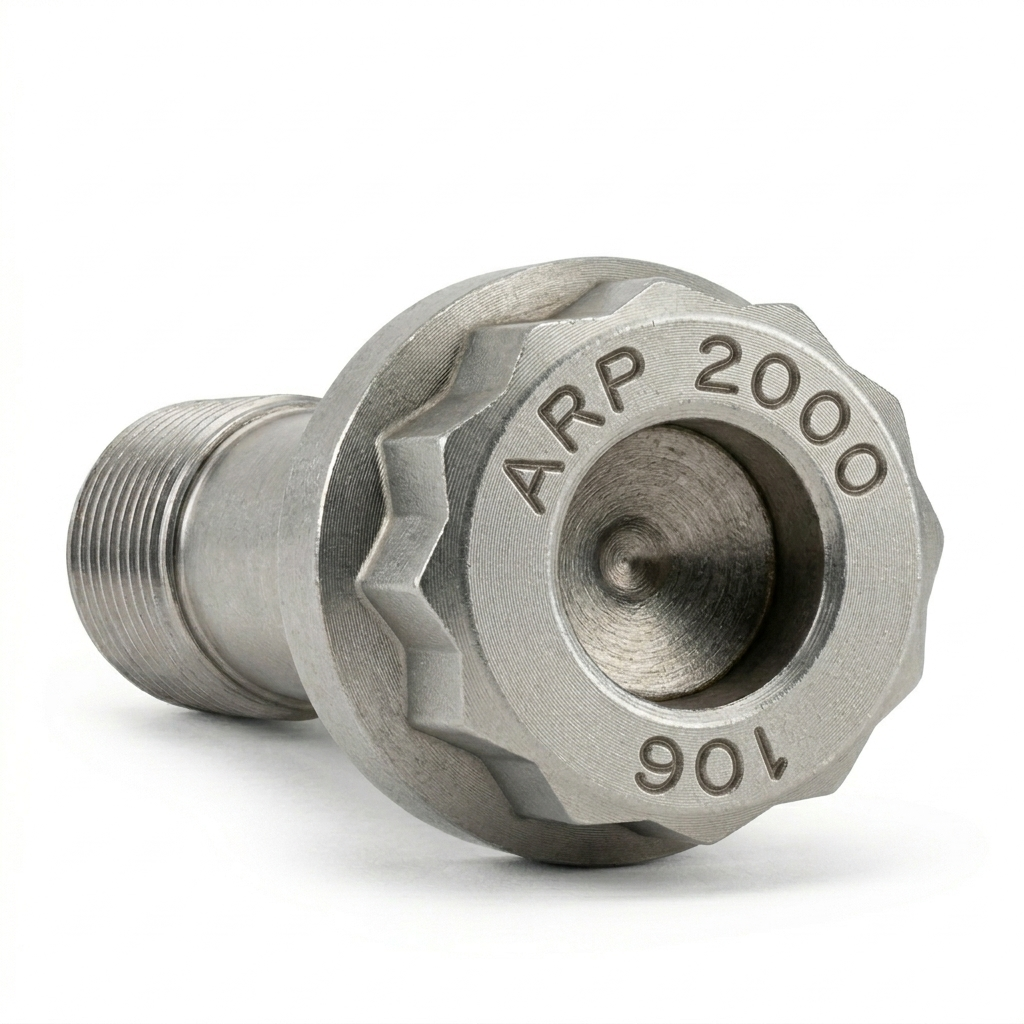 | ARP 2000 (tensile strength around 220,000 psi, i.e. ~1,517 MPa) is the high-performance standard. It suits builds up to 200 hp per cylinder in 3/8″, and up to 8,500 rpm. It is the most widely used grade in circuit racing, track days, rally, drift, drag and hillclimb: robust, reliable and versatile, with no particular storage precaution. |
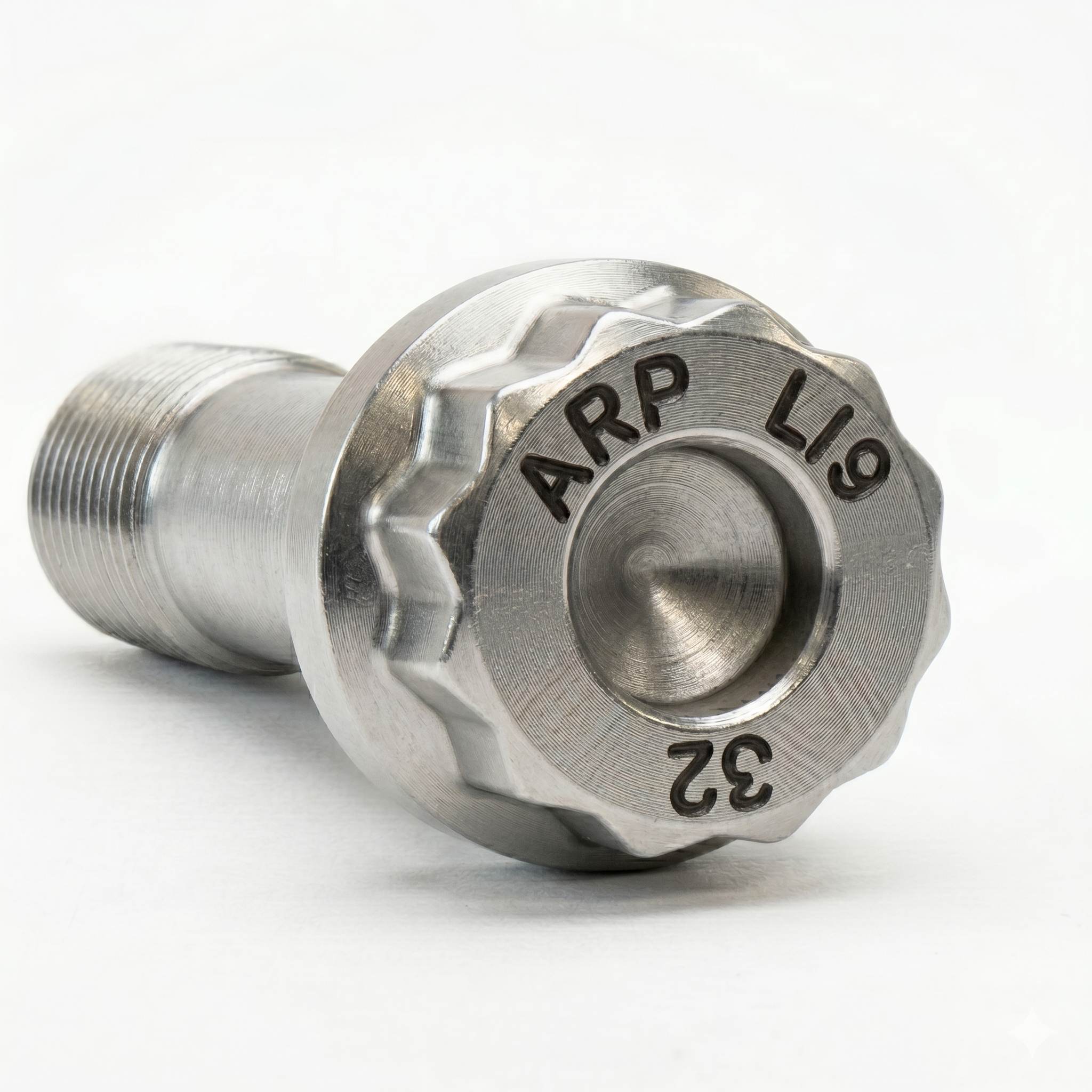 | L19 (tensile strength ~260,000 psi, i.e. ~1,793 MPa) raises the ceiling to 250 hp per cylinder in 3/8" and 10,000 rpm. On the Busso V6 it is aimed at builds running very high boost pressure, sustained high engine speeds and high cylinder pressure, and it is the choice of the big-power cars in drag, drift, rally and circuit racing. Its use leaves no room for approximation: the twelve bolts of the six ZRP H-profile rods are fitted with flawless threads and seats, coated with assembly lubricant, tightened in several passes and validated through stretch measured with a dial gauge, with the free length recorded for each one. Sensitive to corrosion and to hydrogen embrittlement, it must be stored and fitted oiled, away from moisture, and checked before every rebuild. |
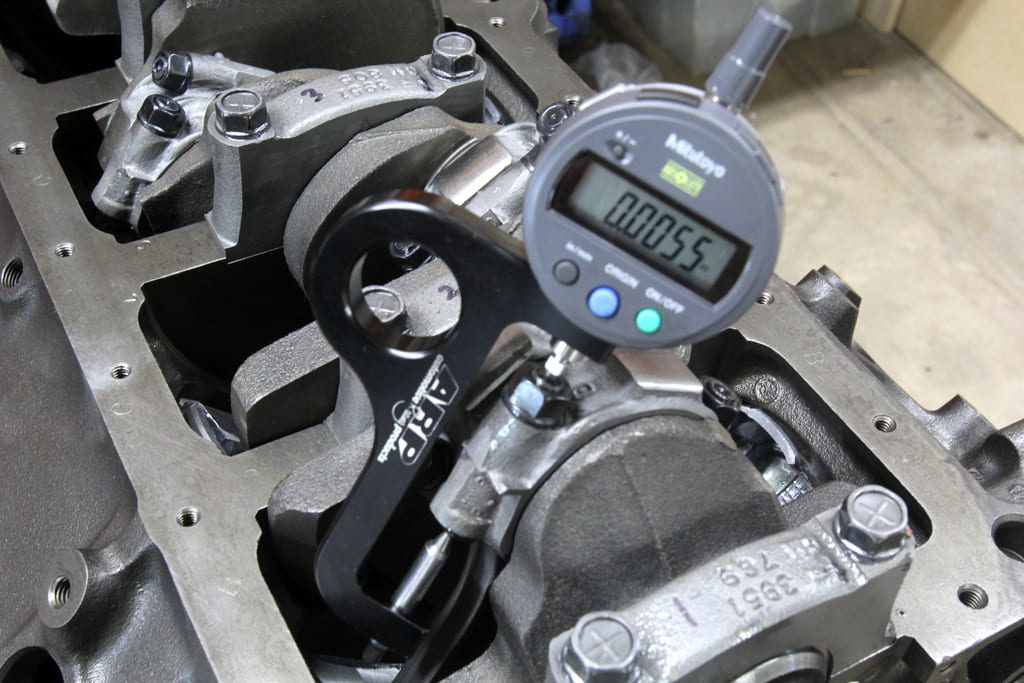
| Beyond torque tightening, measuring bolt stretch is the most reliable way to reach the ideal preload. With the bolt fitted, a gauge (dial indicator) is applied to both ends of the bolt to read its actual stretch, to be compared with the recommended value (see the torque and stretch table above). This method removes the friction variations inherent to torque tightening and secures the assembly on heavily stressed engines. |
 | ZRP is a Greek brand of high-performance forged connecting rods, designed in Athens by Alex Drakos. Each rod is forged from 4340 steel, precision-machined and balanced to ±1 g to stay reliable at high rpm. Designed and inspected in Greece, proven in rally, on track and in drift, they are offered here in H-beam profile with ARP 2000 or ARP L19 hardware. |
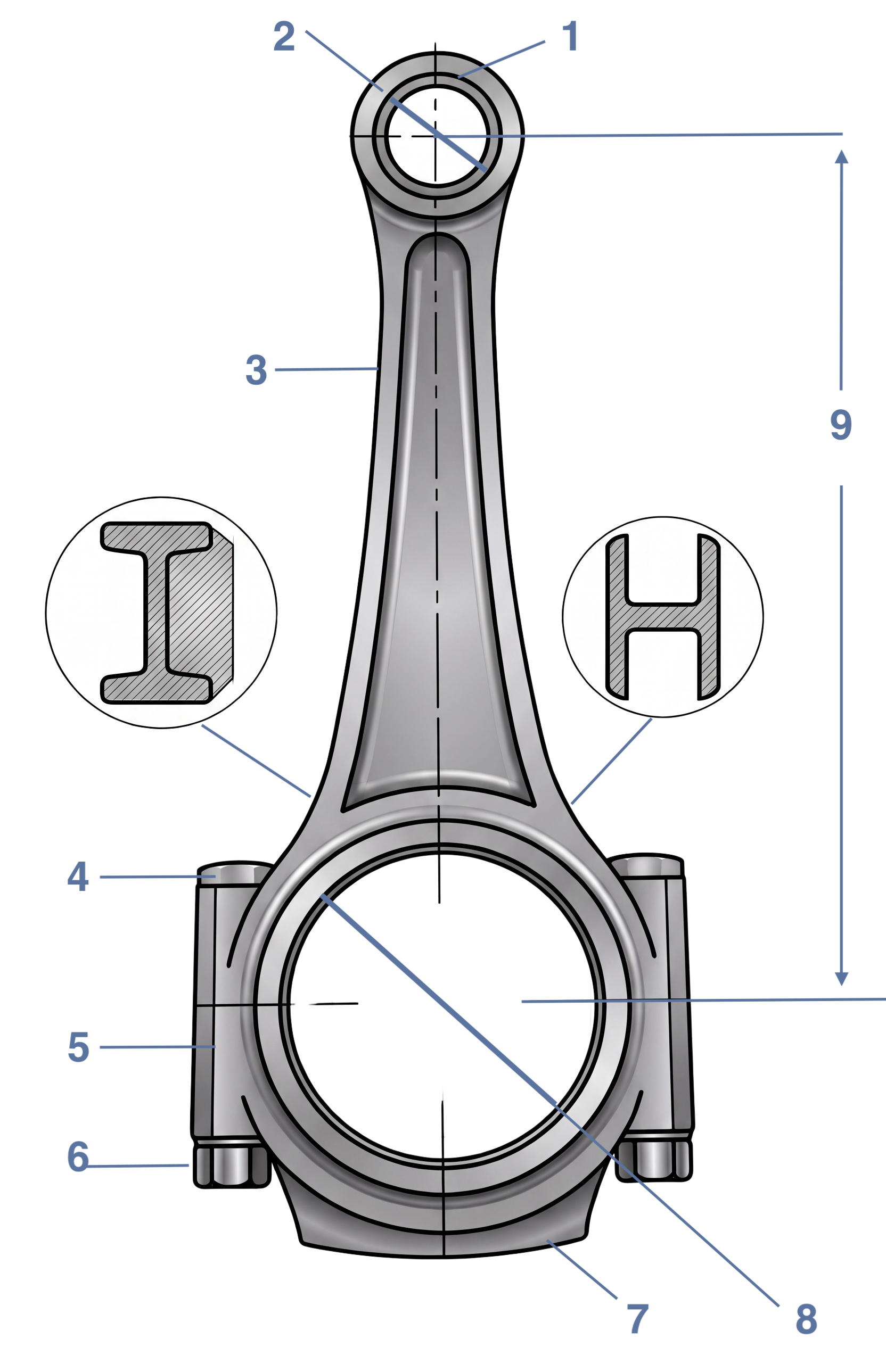 | 1) Small end 2) Small-end diameter 3) Rod beam 4) Rod bolt 5) Big end 6) Rod nut / bolt 7) Rod cap 8) Big-end diameter 9) Center-to-center |
These forged rods fit the Busso V6 engines that share the same rotating-assembly architecture (131 mm centre distance). The original rod carries a single part number across the whole family.
| Make | Model (chassis) | Engine code | Power | Years |
|---|---|---|---|---|
| Alfa Romeo | 75 (162B) | AR064 · 2.5 V6 12v | 156 hp | 1985–1992 |
| Alfa Romeo | GTV6 (116) | AR064 · 2.5 V6 12v | 160 hp | 1980–1986 |
| Alfa Romeo | 164 | AR064 · 3.0 V6 24v | 232 hp | 1992–1998 |
| Alfa Romeo | 166 (936) | AR064 · 3.0 V6 24v | 226 hp | 1998–2005 |
OEM reference: 6 066 2848 (set of 6 rods).
Repairing a stock bottom end after a failure (a rod broken, bent or scored) forces you to replace rods and pistons together, almost always damaged at the same time, just to get back to standard. The bill climbs fast, with no gain.
For a comparable, sometimes lower budget, fitting forged 4340 rods and forged pistons right at the build stage brings far higher reliability and safety margin, plus real headroom to evolve. It is the choice European engine builders have made for more than fifteen years.
For the same budget: more reliability, more potential, more longevity.