
Product successfully added to your shopping cart
Quantity
Total
There are 0 items in your cart. There is 1 item in your cart.
Total products
Total shipping To be determined
Total

1.6L 16v - 4A-GE
Manufacturers
1.6L 16v - 4A-GE
 View larger
 Warning: Last items in stock!
New product
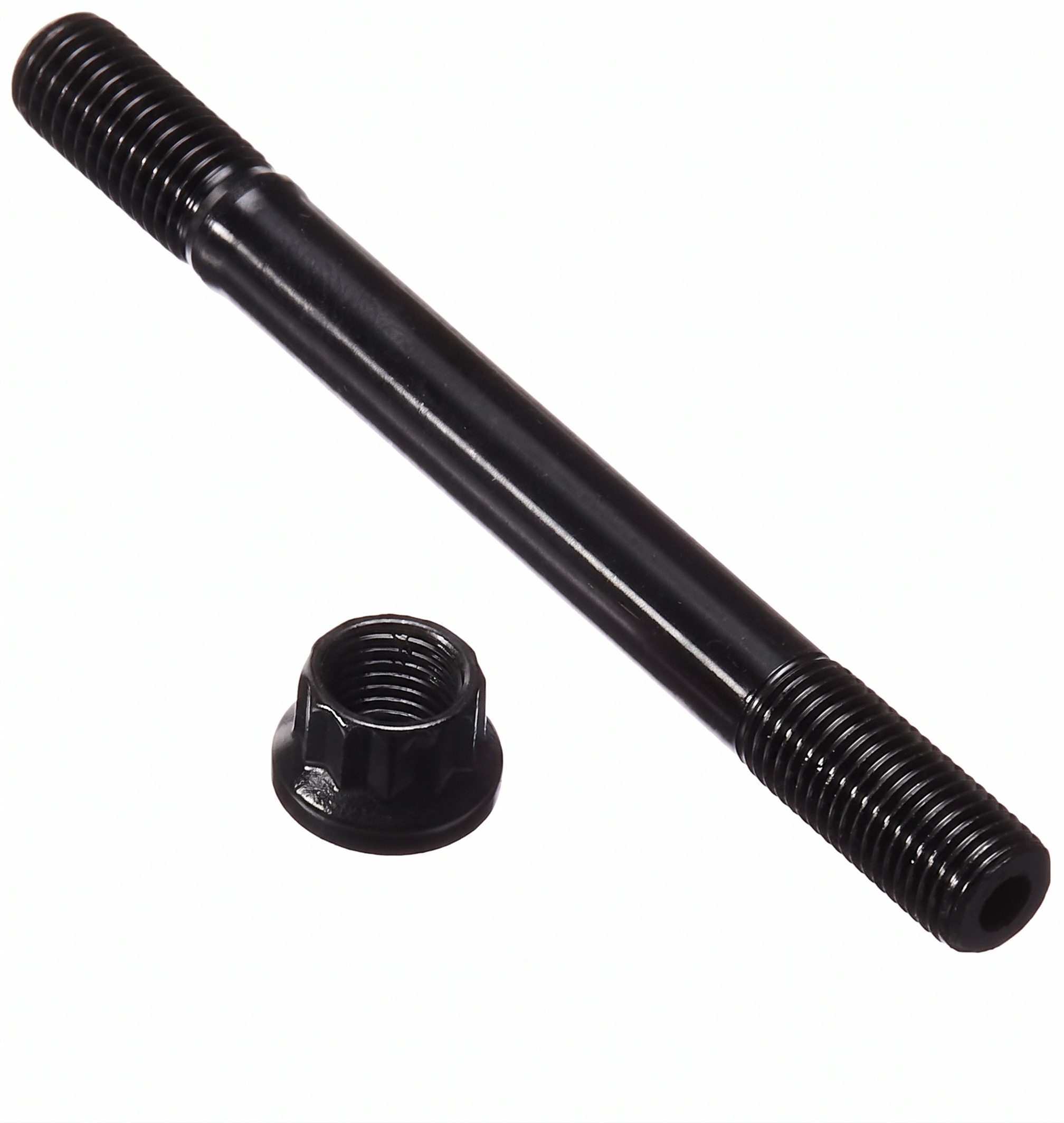
ARP cylinder head studs for Toyota 4A-GE 16 and 20 valve (inline four-cylinder).
The 4A-GE is Toyota's 1.6-litre naturally aspirated inline four-cylinder (81 mm original bore), offered in 16-valve and 20-valve versions (Silver Top and Black Top). It powers the Corolla AE86 and AE92 GTi, the MR2 AW11 and the Corolla Levin and Sprinter Trueno AE101 and AE111, among others. ARP matches kit 203-4203 to the 4A-GE 16-valve and kit 203-4304 to the 4A-GE 20-valve.
As standard, the 4A-GE 16-valve cylinder head (1988 to 1991) is tightened to 29 Nm and then through two 90° stages.
Cylinder head fasteners work constantly: they hold the head tight against the block, crush the gasket to the right value and hold back the push of the gases at every combustion. If they lose even a little tension, the gasket starts to leak.
Two ARP stud kits with nuts, both with an M10 x 1.25 thread, are offered for these engines: the 203-4203, in 8740, for the 4A-GE 16-valve, and the 203-4304, in ARP2000, for the 4A-GE 20-valve.
According to the instruction sheets, the studs are screwed into the block by hand first; the cylinder head is fitted afterwards, then washers and nuts are tightened to torque in the manufacturer's order.
8740 is a chrome-molybdenum steel, rated by ARP at 190,000 psi tensile strength. As a reference point, an engine's standard fasteners mostly belong to property classes 10.9 and 12.9, with a minimum tensile strength between 150,800 and 176,900 psi.
The ARP2000 range relies on an alloy steel developed by ARP: after heat treatment it reaches 220,000 psi tensile strength, and the threads are rolled afterwards. As standard bolts generally belong to classes 10.9 and 12.9, i.e. 150,800 to 176,900 psi minimum, ARP2000 exceeds them by 24 to 46 %.
On this four-cylinder engine, the limit of the 8740 studs in M10 x 1.25 lies at 500 hp (calculated estimate). These ARP2000 studs in M10 x 1.25 are calculated to handle up to 600 hp on this four-cylinder engine (calculated estimate).
| Brand | Grade / material | Nuts | Thread |
| ARP | 8740 | ARP nuts | M10 x 1.25 |
| ARP | ARP2000 | ARP nuts | M10 x 1.25 |
| Part number | Stage 1 | Stage 2 | Stage 3 |
| ARP-203-4203 | 27 Nm | 54 Nm | 81 Nm |
| ARP-203-4304 | 32 Nm | 63 Nm | 95 Nm |
For both kits: the studs are fitted into the block by hand, without a torque wrench. For a permanent installation, the instruction sheet accepts thread locker, with tightening to be completed before it sets.
If the studs open into a water jacket, the instruction sheets call for an ARP sealant on their threads.
Tightening to torque is done in three steps, in the order set by the engine manufacturer, with ARP lubricant applied to the threads and under the nuts, a condition for the table values to apply.
The instruction sheet also calls for ARP lubricant on the washers.
The torque figures above come from ARP instruction sheets 203-4203 and 203-4304; only the official sheet in force applies, including for the full procedure and the tightening sequence. Read the ARP 203-4203 instruction sheet ; Read the ARP 203-4304 instruction sheet
The stated tightening torques only make sense with ARP assembly grease, applied to the threads and under the nuts.
| Buy the ARP assembly grease → |
 | Gary Holzapfel, a former aerospace engineer, created ARP (Automotive Racing Products) in the early 1970s to tackle engine failures caused by insufficiently strong fasteners in racing. Today the brand develops and manufactures thousands of parts in California, available in several material grades as needed. |
| Criterion | Original head bolts | 8740 studs | ARP2000 studs |
 |  | | |
| Tightening method | Torque then angle (16-valve, 1988-1991) | Torque only, in 3 stages | Torque only, in 3 stages |
| Block threads | Stressed at every tightening | Preserved (studs fitted hand tight) | Preserved (studs fitted hand tight) |
On an engine left standard, the original fasteners do their job. Switching to reinforced fasteners becomes worthwhile as soon as:
| Model | Engine code | Power | Years |
| Toyota Corolla AE92 GTi 16 | 4A-GE 16v | 124-129 hp | 1987-1992 |
| Toyota Corolla FX16 (AE82) | 4A-GE 16v | 115 hp | 1987-1988 |
| Toyota Corolla Levin / Sprinter Trueno AE86 | 4A-GE 16v | 120-128 hp | 1983-1987 |
| Toyota MR2 AW11 | 4A-GE 16v | 112-130 hp | 1984-1989 |
| Toyota Corolla (E101) Ceres | 4A-GE 20v Silver Top | 160 hp | 1992-1995 |
| Toyota Corolla (E111) BZ-G / BZ-R | 4A-GE 20v Black Top | 165 hp | 1995-2000 |
| Toyota Corolla Levin AE101 | 4A-GE 20v Silver Top | 160 hp | 1991-1995 |
| Toyota Corolla Levin AE111 | 4A-GE 20v Black Top | 165 hp | 1995-2000 |
| Toyota Sprinter AE101 | 4A-GE 20v Silver Top | 160 hp | 1991-2000 |
| Toyota Sprinter AE111 / Sprinter Carib | 4A-GE 20v Black Top | 165 hp | 1997-2000 |
| Toyota Sprinter Marino AE101 | 4A-GE 20v Silver Top | 160 hp | 1992-1995 |
| Toyota Sprinter Trueno AE101 | 4A-GE 20v Silver Top | 160 hp | 1991-1995 |
| Toyota Sprinter Trueno AE111 | 4A-GE 20v Black Top | 165 hp | 1995-2000 |
The original head fasteners are sized for stock power: as soon as combustion pressure rises, the gasket and the fasteners are the first to suffer. Reinforced in 8740 or ARP2000, ARP fasteners withstand a clearly higher pressure; the risk of a failed gasket or a broken bolt drops, and with it the risk of a repair costing far more than the kit.