- In stock


Trimetal connecting rod bearings BMW M40 M42 M43 M44
Set of 8 trimetal connecting rod half-bearings for BMW inline-four M40, M42, M43 and M44.
- Brands and treatments: ACL Race and King Racing
- Compatibility: E30, E34, E36, E46, Z3
- Engine codes: M40B16, M40B18, M42B18, M43B16, M43B18, M43B19, M44B19
- Available sizes: standard to +0.50 mm, increased-clearance version (HX)
The BMW M40, M42, M43 and M44 four-cylinder engines
Launched in 1987, the M40 introduced a new generation of BMW inline four-cylinder engines: cast iron block, single overhead camshaft and two valves per cylinder, in 1.6 and 1.8 litre form. The M42 arrived in 1989 with an aluminium cylinder head, twin camshafts and four valves per cylinder. The M43 replaced the M40 in 1993, still with two valves per cylinder, and the M44 succeeded the M42 in 1995 with displacement raised to 1.9 litres. All share the same connecting rod journal diameter: a single bearing set covers the whole family.
From the factory, these engines are fitted with Glyco connecting rod bearings, BMW part number 11 24 1 284 849 to 854, supplied as half shells graded red and blue: BMW pairs two different grades on the same rod to absorb the machining tolerances of the journal. These are bi-metal bearings, a steel back coated with an aluminium alloy, sized for the loads of a standard engine. As soon as power, engine speed or boost pressure increase, this construction reaches its limits.
Trimetal connecting rod bearings
A trimetal bearing combines three layers with complementary roles: a steel back that provides structural strength, a copper-lead intermediate layer that takes the heavy loads and an anti-friction running layer that protects the crankpin. The complete set contains 8 half shells, i.e. 4 pairs.
An aluminium bi-metal bearing, intended for low to medium loads, tops out at around 8,000 psi; a performance trimetal bearing holds up to 12,000 psi, 50% more load capacity. It therefore gains strength and service life on turbocharged, supercharged or high-revving engines.
Technical specifications
| ACL / King bearings Crankpin Ø 44.973 / 44.991 mm Housing bore Ø 48.000 / 48.016 mm Width 18 mm |
OEM reference Crankpin Ø 44.975 / 44.991 mm |
| Reference | Brand and treatment | Size | Wall thickness (mm) OEM : 1.493 |
|---|---|---|---|
| 4B1490H-STD | ACL Race - Untreated | Standard | 1.490 |
| 4B1490HX-STD | ACL Race - Untreated | Std, increased clearance (HX) | 1.477 |
| 4B1490H-.025 | ACL Race - Untreated | +0.025 | 1.503 |
| 4B1490H-.25 | ACL Race - Untreated | +0.25 | 1.615 |
| 4B1490H-.50 | ACL Race - Untreated | +0.50 | 1.740 |
| CR4042XP | King Racing - Untreated | Standard | 1.491 |
| CR4042XP.026 | King Racing - Untreated | +0.026 | 1.504 |
| CR4042XP0.5 | King Racing - Untreated | +0.50 | 1.745 |
Running clearance
Running clearance is the space left between the bearing and the crankpin, permanently filled by the oil film.
With the engine running, the crankpin does not touch the bearing: it rides on this oil film, which takes the load. The clearance sets the film thickness. Too small, it restricts oil flow, raises the temperature and invites seizure; too large, it lets the oil escape, the film loses its load capacity and oil pressure falls. The right clearance combines sufficient lubrication with an oil film that keeps carrying the load.
| Size / grade | When to choose it | ACL Race Series | King XP |
|---|---|---|---|
| Standard (STD) | Standard journal, not reground | 0.049 to 0.058 mm | 0.045 mm - 0.052 mm |
| Increased clearance (HX) | Wider clearance: high oil flow, high rpm | 0.074 to 0.083 mm | |
| +0.025 / +0.026 mm | Polished journal | 0.049 to 0.058 mm | 0.045 mm - 0.052 mm |
| +0.25 mm | Journal reground to 0.25 mm | 0.049 to 0.058 mm | |
| +0.50 mm | Journal reground to 0.50 mm | 0.049 to 0.058 mm | 0.045 mm - 0.052 mm |
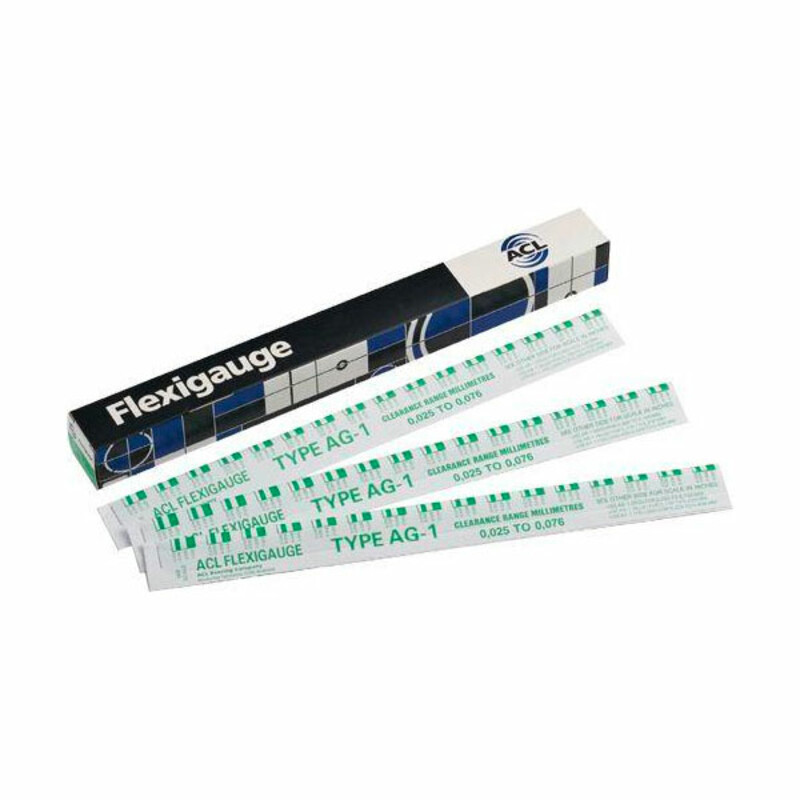
Checking on assembly: lay a calibrated strip (Plastigauge) on the journal, torque the rod cap to spec (see the torque table below), then compare the crushed strip against the gauge to read the clearance.
Connecting rod bolt torques
| Bolts | By torque | By stretch (gauge) |
| Original bolts (OEM), M40/M42/M43/M44 | 5 Nm + 20 Nm + 70° | |
| Forged rod, ARP2000 (3/8″ × 38 mm) |
61 Nm | 0.140 to 0.152 mm |
| Forged rod, ARP L19 (3/8″ × 38 mm) |
67.8 Nm | 0.152 to 0.165 mm |
ARP recommends the stretch method (gauge).
Technical guide
The ACL and King connecting rod bearings shown here are trimetal bearings built for engine tuning and racing. They withstand far higher loads than a standard bearing and come in several sizes: the standard size, a +0.025 / +0.026 mm size for a crankpin that has only been polished, +0.25 and +0.50 mm regrind sizes and the HX version with increased clearance for high-revving engines or engines needing a high oil flow. This range lets you refit a reground crankshaft without changing product line and match the clearance to the oil and use chosen.
The two brands
 |
Founded in Australia in 1949, ACL Bearing Company designs high-performance engine bearings. Its Race Series brings together precision trimetal bearings, offered in a wide choice of sizes and fitted to built engines around the world. |
 |
An Israeli maker of high-performance engine bearings since the 1960s, King Engine Bearings developed the pMax Black trimetal alloy for heavy loads. |
Construction and advantages
| Criterion | ACL Race Series | King Racing |
| Cross-section | 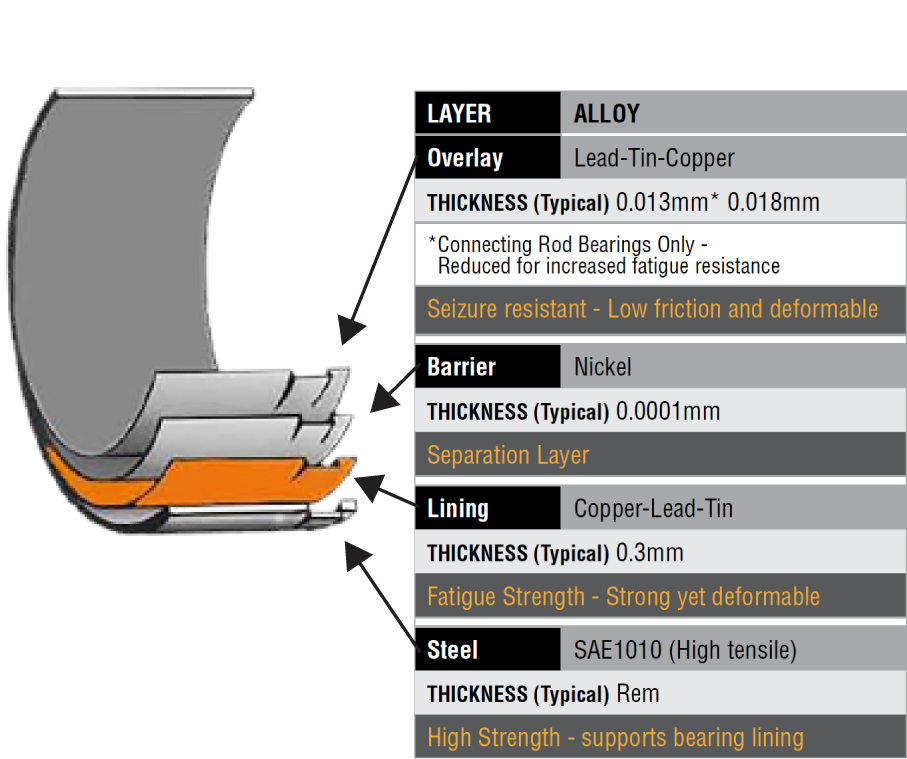 |
 |
| Type | High-performance trimetal bearing | High-performance trimetal bearing |
| Country of manufacture | Australia | Israel |
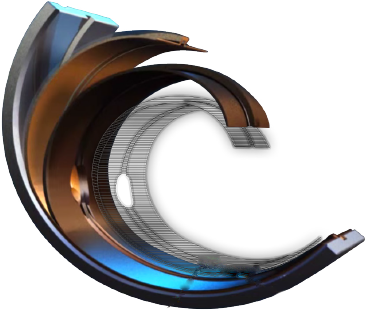
| Construction | Trimetal: steel back, copper layer, soft surface | Trimetal: steel back, copper layer, soft surface |
| Alloy | Race Series (copper-lead) | pMax Black (hardened copper-lead) |
| Protective coating | No | No |
| Available sizes | Standard to +0.50 mm (+ increased clearance HX) | Standard, +0.026 and +0.50 mm |
Vehicle compatibility
This connecting rod bearing set fits all BMW four-cylinder engines that share the same connecting-rod journal diameter:
| Brand | Model (chassis) | Engine code | Power | Years |
|---|---|---|---|---|
| BMW | 3 Series (E30) 316i | M40B16 | 99–102 hp | 1987–1994 |
| BMW | 3 Series (E36) 316i | M40B16 | 100 hp | 1991–1993 |
| BMW | 3 Series (E30) 318i | M40B18 | 113–115 hp | 1987–1994 |
| BMW | 3 Series (E36) 318i | M40B18 | 113 hp | 1990–1994 |
| BMW | 5 Series (E34) 518i | M40B18 | 113 hp | 1989–1994 |
| BMW | 3 Series (E30) 318i / 318is | M42B18 | 136–140 hp | 1989–1992 |
| BMW | 3 Series (E36) 318i / 318is / 318ti | M42B18 | 140 hp | 1992–1995 |
| BMW | 3 Series (E36) 316i / 316g | M43B16 | 102 hp | 1993–2000 |
| BMW | 3 Series (E46) 316i / 316Ci | M43B16 | 105 hp | 2000–2006 |
| BMW | 3 Series (E36) 318i | M43B18 | 115–116 hp | 1993–1999 |
| BMW | 5 Series (E34) 518i / 518g | M43B18 | 101–115 hp | 1994–1996 |
| BMW | Z3 Roadster (E36) 1.8i | M43B18 | 116 hp | 1995–1998 |
| BMW | 3 Series (E36) 316i | M43B19 | 105 hp | 1999–2000 |
| BMW | 3 Series (E46) 316i / 318i / 318Ci | M43B19 | 105–118 hp | 1997–2002 |
| BMW | Z3 Roadster (E36) 1.9i | M43B19 | 116–118 hp | 1998–2003 |
| BMW | 3 Series (E36) 318is / 318ti | M44B19 | 140 hp | 1995–1999 |
| BMW | Z3 Roadster (E36) 1.9i | M44B19 | 140 hp | 1995–1999 |
Why replace the bearings
A failing connecting rod bearing does not fail alone: it scores the crankpin, sends debris through the oil circuit and calls at least for a crankshaft regrind, when it does not also take out the rod and the block. On a built engine, a bearing set costs only a fraction of a regrind, and even less of a full rebuild: it is the cheapest part of the rotating assembly and the one whose failure costs the most.
-
Brand
-
Reference4B1490H-STD
12 other products in the same category
Viewed products