Product successfully added to your shopping cart
Quantity
Total
There are 0 items in your cart. There is 1 item in your cart.
Total products
Total shipping To be determined
Total

2.0L 16v - XU10J4
Manufacturers
2.0L 16v - XU10J4
Warning: Last items in stock!
New product
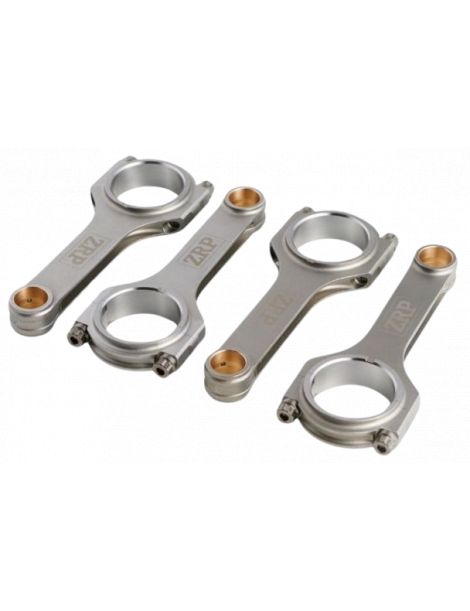
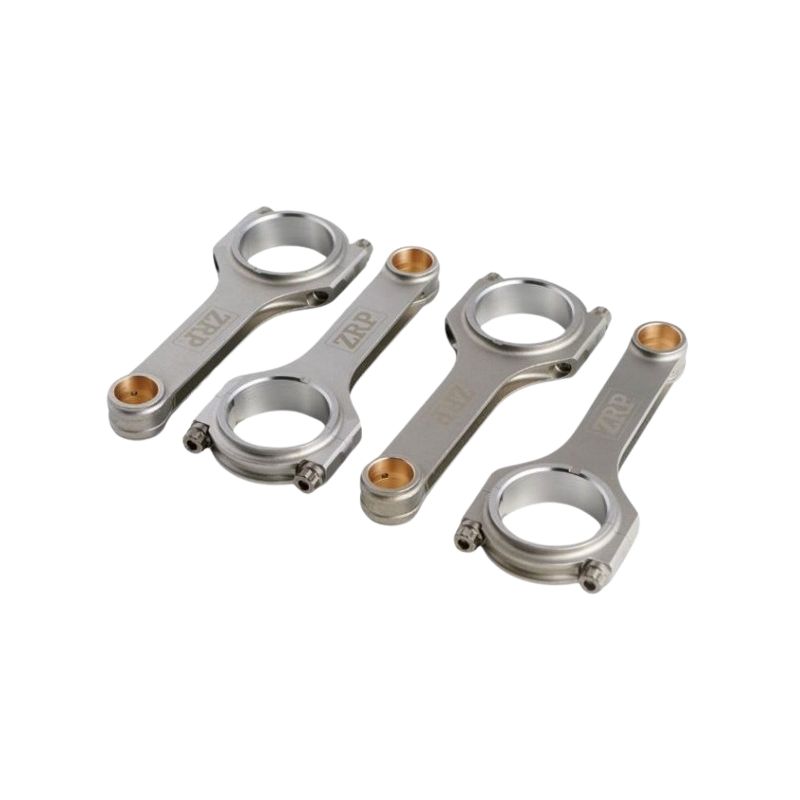
Set of 4 forged connecting rods in 4340 steel for Citroën / Peugeot 2.0 16V XU10J4.
The PSA XU10J4 is a 2.0-litre 16-valve inline four-cylinder from the well-known XU family, jointly developed by Peugeot and Citroën. Naturally aspirated, it pairs a cast-iron cylinder block renowned for its near-indestructible durability with an aluminium DOHC head and belt-driven timing. It displaces 1,998 cc (86 mm bore × 86 mm stroke, a "square" engine) with a compression ratio of 10.4 to 10.8:1. Depending on the version, XU10J4 (RFY), XU10J4R (RFV) or XU10J4Z, output ranges from roughly 132 to 155 hp with torque around 180 to 195 Nm. The hottest variants, such as the XU10J4 in the 306 S16 and 405 Mi16, use the ACAV variable-length intake and reach 155 hp.
Fitted across a broad Peugeot and Citroën range (306 S16, 405 Mi16, 406, 605, 806, Citroën ZX, Xantia, Xsara and XM), the XU10J4 stayed in production from about 1992 to 2005. With its cast-iron block, integral liners and sturdy crankshaft, it is one of the favourite bases among French tuners for racing and power upgrades. To make a high-revving, high-compression or forced-induction (turbo or supercharger) build reliable, the weak link is the original rotating assembly, which these forged connecting rods replace.
Machined from high-strength 4340 nickel-chrome-molybdenum steel, these forged connecting rods reinforce the rotating assembly as soon as power or engine speed rise. They become essential when switching to forged pistons, working the cylinder head, raising the compression ratio, increasing displacement or converting to forced induction: all cases where the mass-produced factory rod, optimised for series cost, reaches its limits.
Engineered to withstand the high loads of tuned engines, in high-performance naturally aspirated form as well as turbo or supercharger builds, these forged rods cover every discipline: rally, hillclimb, circuit and track days, drift, drag and time attack. They suit Stage 2, Stage 3 and Stage 4 and beyond, up to full competition engines.
| Reference | Brand | Profile | Bolts | Pin diameter | Small-end width | Big-end diameter | Big-end width | Center-to-center | Weight per rod |
|---|---|---|---|---|---|---|---|---|---|
| R-PEU-008-H | ZRP | H | ARP 2000 | 23 mm | 152 mm |
| Rod | Bolts | Torque | Recommended stretch |
|---|---|---|---|
| ZRP (H-beam) | ARP 2000 (3/8") | 61 N·m | 0,140–0,152 mm |
Manufacturers recommend measuring bolt stretch (stretch gauge) as the reference method for tightening rod bolts; the instructions supplied with the kit always take precedence. Where a tightening torque is given, it assumes ARP lubricant.
| 4340 is a low-alloy nickel-chrome-molybdenum steel used in aerospace as well as motorsport. Forged under press and then heat-treated (quench and temper), it combines high tensile strength, excellent fatigue endurance and good ductility. Compared with a factory rod (often powder-metal, designed primarily for series cost), a forged 4340 rod gains on the order of +19% in yield strength, +8% in tensile strength and, above all, +19 to +37% in fatigue resistance, meaning a far longer life under cyclic loading. This is what makes forged 4340 the reference material as soon as engine speed and load climb. |
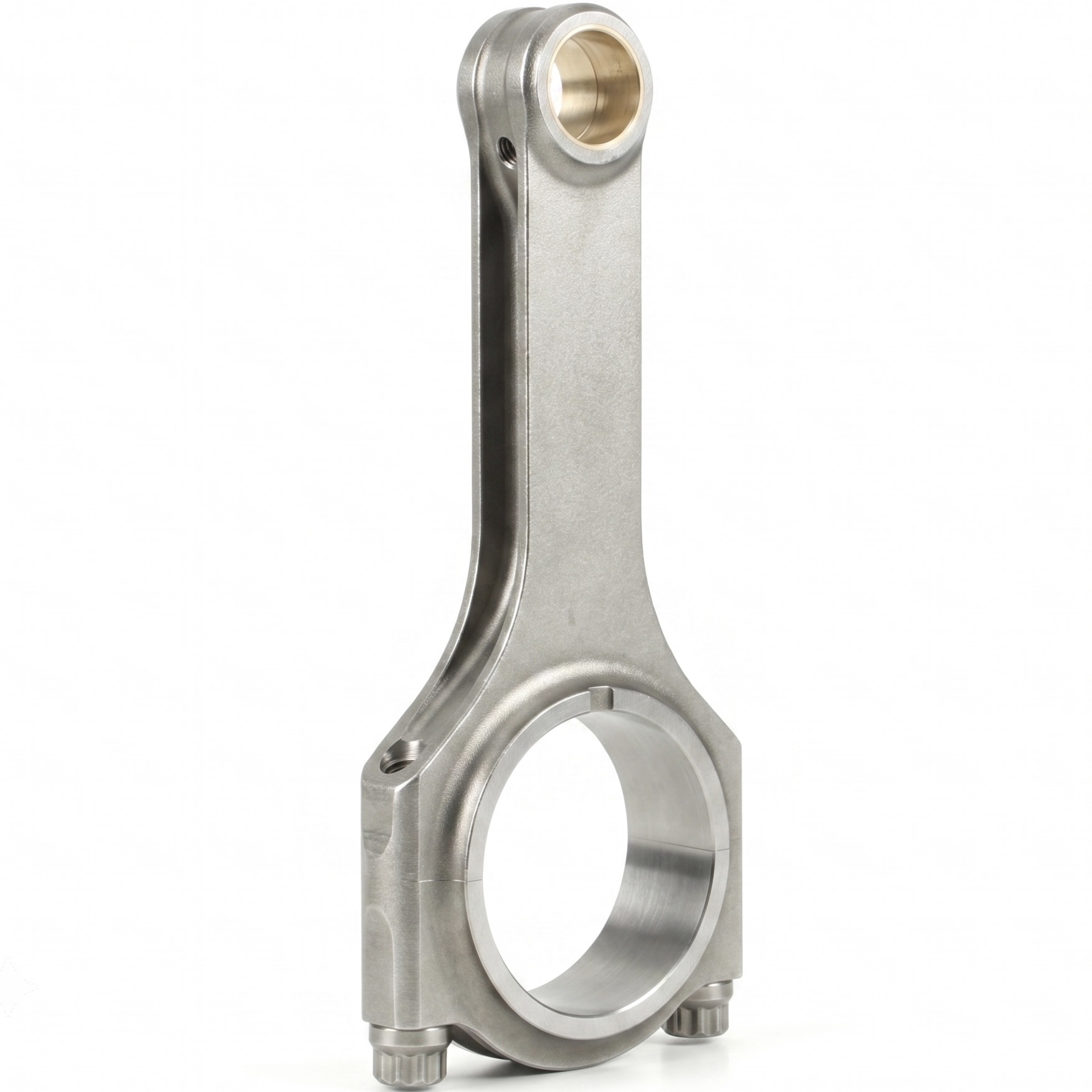 | H-beam profile. Its "H" section gives it great rigidity and outstanding resistance to bending and compression. A little heavier than an I-beam rod, it prioritises strength above all: it is the profile of choice for high-torque engines, large displacements and drag use. On an XU10J4 built for reliability and endurance, including forced-induction conversions, it is a safe bet. |
The rod bolt is among the most heavily stressed parts of the whole engine. The principle is simple: match the ARP grade to the real level of the build, then strictly follow the specified tightening torque and stretch.
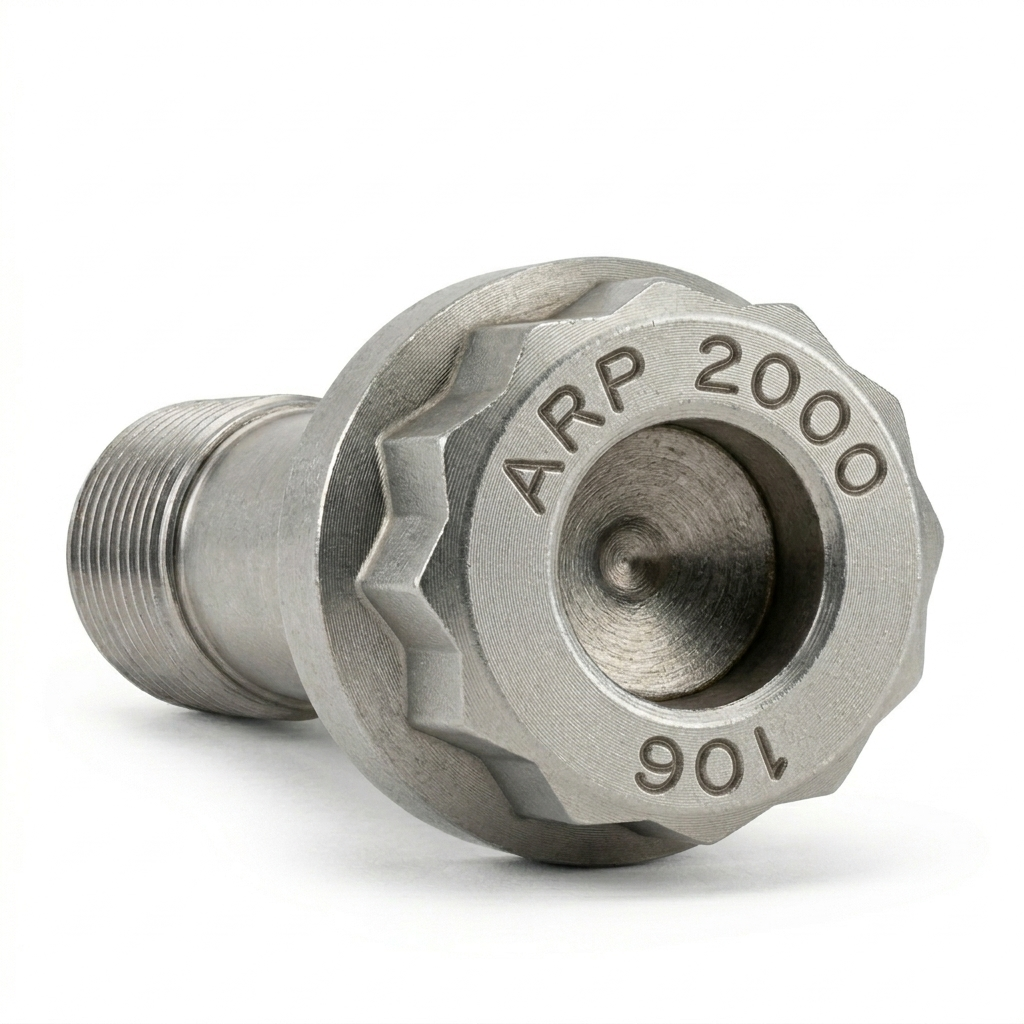 | ARP 2000 (tensile strength around 220,000 psi, i.e. ~1,517 MPa) is the high-performance standard. Suited to builds up to 200 hp per cylinder in 3/8 inch, and up to 8,500 rpm, it is the most common grade in circuit, track, rally, drift, drag and hillclimb use, valued for its robustness. |
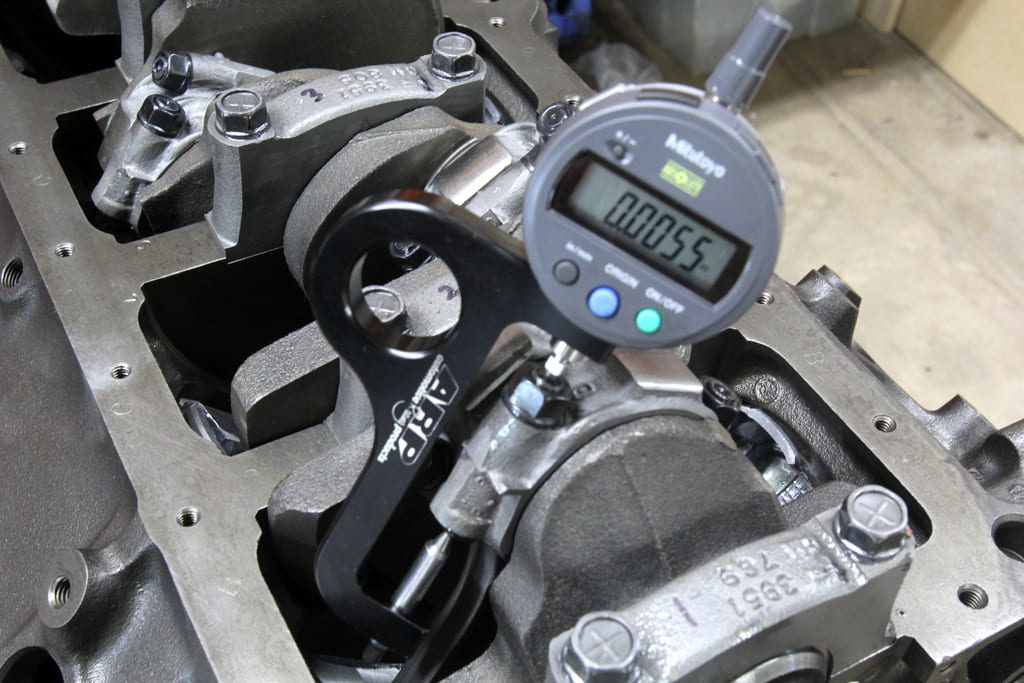
| In addition to torque tightening, measuring rod-bolt stretch is the most reliable check for achieving correct preload. With the bolt fitted, place the dial gauge (stretch gauge) on both ends of the bolt and read its actual stretch, which must match the value specified by the manufacturer in the kit instructions. This method removes the friction scatter inherent in torque tightening and secures the assembly on heavily stressed engines. |
 | ZRP is a Greek high-performance forged connecting rod brand, designed by Alex Drakos in Athens. Each rod is forged from 4340 steel, precision-machined and balanced to ±1 g to stay reliable at high rpm. Available in I-beam or H-beam profiles with ARP 2000 bolts, they are developed and inspected in-house for engine building and motorsport. |
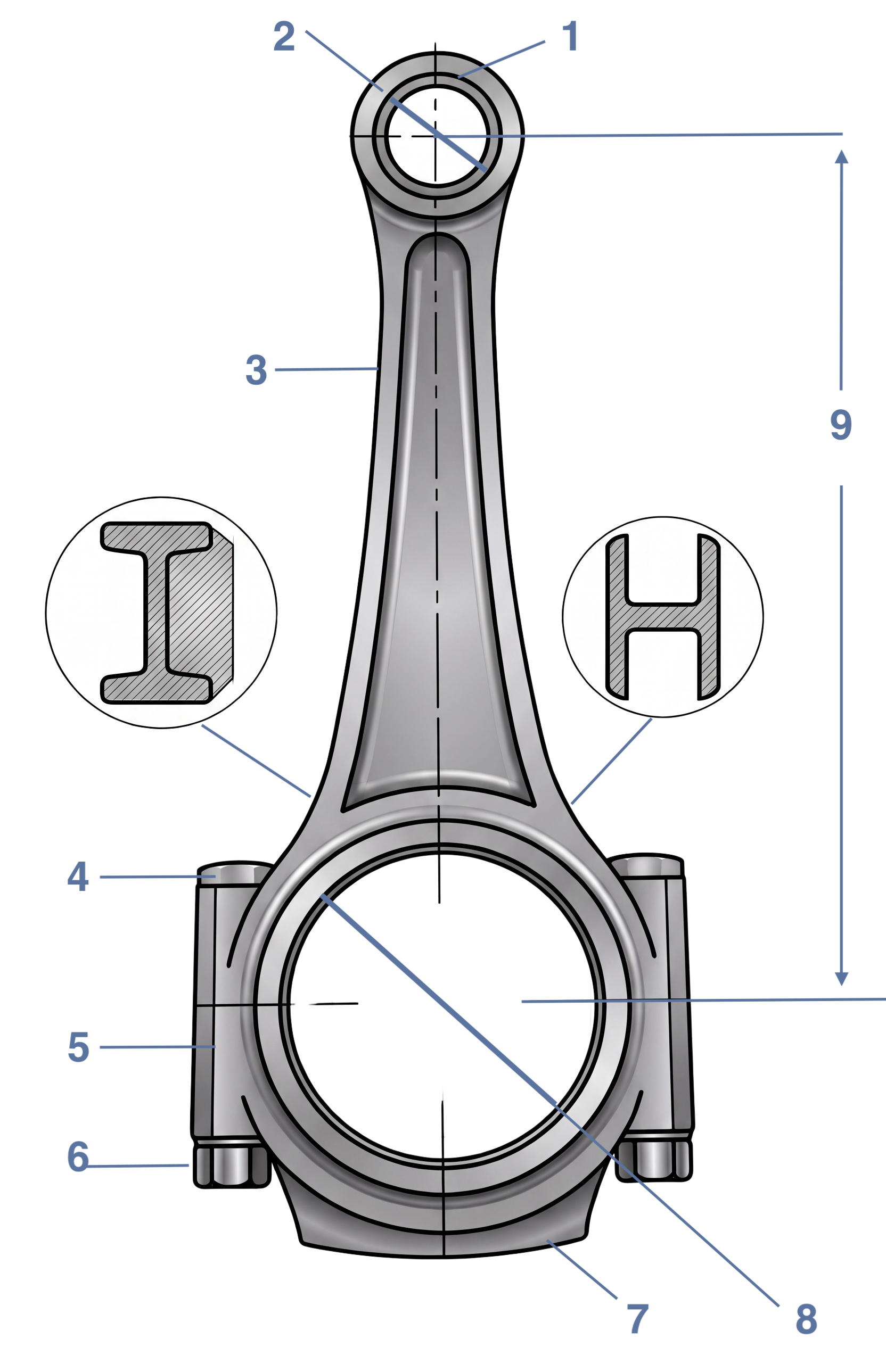 | 1) Small end 2) Small-end diameter 3) Rod beam 4) Rod bolt 5) Big end 6) Rod nut / bolt 7) Rod cap 8) Big-end diameter 9) Center-to-center |
These forged connecting rods are compatible with Peugeot and Citroën vehicles fitted with the 2.0 16V XU10J4 (RFY), XU10J4R (RFV) and XU10J4Z engine:
| Brand | Model (chassis) | Engine code | Power | Years |
|---|---|---|---|---|
| Peugeot | 306 S16 (N3/N5) | XU10J4 (RFY) | 155 hp | 1993-2001 |
| Peugeot | 405 Mi16 (4B) | XU10J4 (RFY) | 155 hp | 1992-1995 |
| Citroën | ZX 16V (N2) | XU10J4 (RFY) | 155 hp | 1992-1994 |
| Peugeot | 306 2.0 16V (N3/N5) | XU10J4R (RFV) | 132-136 hp | 1997-2000 |
| Peugeot | 406 (D8/D9) | XU10J4R (RFV) | 132-136 hp | 1996-2000 |
| Peugeot | 605 (Y30) | XU10J4R (RFV) | 132-136 hp | 1995-1999 |
| Peugeot | 806 (U60) | XU10J4R (RFV) | 132-136 hp | 1998-2002 |
| Citroën | Xantia (X1/X2) | XU10J4R (RFV) | 132-136 hp | 1995-2000 |
| Citroën | Xsara (N6/N7) | XU10J4R (RFV) | 132-136 hp | 1997-2005 |
| Citroën | XM (Y3/Y4) | XU10J4R (RFV) | 132-136 hp | 1995-2000 |
When a factory short block fails (a broken, bent or scored rod), simply returning to the standard configuration means replacing the rods and, more often than not, the pistons damaged at the same time. The bill climbs fast for a mere restoration, with no gain in strength.
For a similar or even lower budget, fitting forged 4340 rods together with forged pistons brings far greater reliability and safety margin, while opening up real potential for future power increases. It is the choice European tuners have made for more than fifteen years.
For the same budget: more reliability, more potential, more longevity.